GuidesCherry tomatoes
How to count tomato trusses and estimate your yield.
"Loads of tomatoes" isn't data. Counting trusses takes a few minutes per plant and gives you a number you can compare between plants and seasons — and, with honest assumptions, a rough idea of your harvest.
In this guide
- What a truss is, and how to count them stem by stem
- A real five-plant example from my office
- An interactive estimator for your own plants
Who this is for: anyone growing cherry tomatoes indoors or on a balcony who wants a rough idea of what their plants will produce — and wants to compare one plant, setup or season with another.
What is a tomato truss?
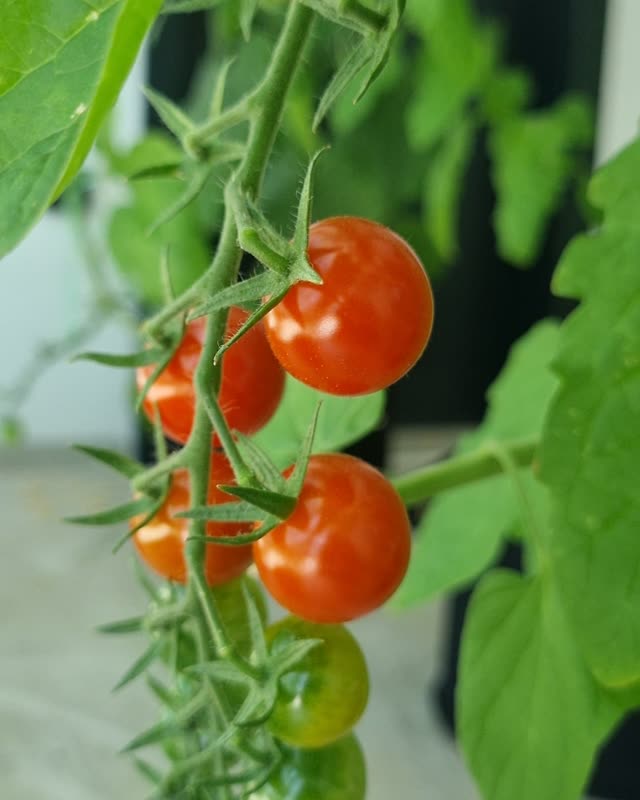
A truss is a cluster of flowers on its own short stalk, growing from a main stem or a side shoot. As the flowers are pollinated, the same cluster becomes a cluster of fruit. On cherry tomatoes, one truss can hold fruit at different stages — ripe, ripening and still green — at the same time.
Reading this photo
- The truss stalk — one shared stalk that all the fruit hangs from.
- Ripe fruit on that truss.
- Green fruit on the same truss, still developing.
Everything inside the outline counts as one truss.
Original photo from my office, 23 July 2026.
Why count trusses?
It's easy to look at a full plant and overestimate. It's also easy to mix up a guess with a result. Counting keeps the two apart: you measure what you can count, and you clearly label everything else as an assumption.
The number of trusses on each stem of each plant.
How many fruits each truss will ripen, and how much each fruit weighs.
How to count them, step by step
Give every plant a code
Notes are useless if you can't tell which plant they belong to.
Do this: Write a short code — A1, A2, B1… — on a tag or on the container.
Work stem by stem
Start at the bottom of the first main stem and follow it up to the top.
Do this: Count every truss (cluster of flowers or fruit) on that stem, then write the number down before moving on.
Then each side shoot
Side shoots carry trusses too, and they're easy to skip.
Do this: Count each side shoot separately and note which main stem it grows from, e.g. "Main stem 2 · side shoot 1: 3".
Add up and double-check
Small slips are common — one of my own notes said 42 where the lines add up to 41.
Do this: Total each plant, then re-add the line items to check the total.
Only then estimate
An estimate needs two assumptions you probably haven't measured.
Do this: Multiply trusses × fruits per truss × grams per fruit, and write the word “estimate” next to the result.
A real example from my office
On 11 September 2026 I counted the trusses on five cherry tomato plants in my office (A1, A2, A3, B1 and B2). Each plant's trusses are recorded on two main stems and on the side shoots growing from them. Here's plant A3.
| Stem | Trusses |
|---|---|
| Main stem | 7 |
| Side shoot 1 | 4 |
| Side shoot 2 | 5 |
| Side shoot 3 | 2 |
| Side shoot 4 | 2 |
| Stem | Trusses |
|---|---|
| Main stem | 9 |
| Side shoot 1 | 3 |
| Side shoot 2 | 8 |
| Side shoot 3 | 4 |
| Side shoot 4 | 2 |
This is a count of trusses — not a count of tomatoes, and not a recorded harvest weight.
All five plants, with charts and the full stem-by-stem record, are in the cherry tomato experiment report.
Turn your count into an estimate
For my own rough estimate I assumed about 13–14 cherries per truss and about 5 g per cherry. I didn't count fruits on every truss and I didn't weigh them, so those two numbers are assumptions. The estimator starts with A3: 46 trusses × 13 fruits × 5 g = 2,990 g. Change any value to try your own.
Estimate your own cherry tomato yield
2.99 kg
- Estimated fruit count
- 598
- Estimated weight
- 2,990 g
46 × 13 × 5 g = 2,990 g
An estimate from assumptions — not a measured harvest. Only weighing what you pick tells you the real yield.
Common mistakes and troubleshooting
Counting the same truss twice
Where main stems and side shoots cross, it's easy to count a cluster from both sides. Follow each cluster back to the point where it joins its stem: one junction = one truss. Clipping a peg on the last truss you counted helps on tall plants.
Confusing flowers with fruit
A truss with only flowers still counts as a truss — but not every flower becomes a fruit. If a plant has many flowering trusses and few set fruits, lower your fruits-per-truss assumption.
Optimistic assumptions
Fruits per truss and fruit weight vary a lot between varieties and conditions. If you can, count fruits on a few trusses and weigh a handful of ripe fruits instead of guessing.
Treating an estimate as a harvest
Some trusses won't ripen and some fruit drops. The estimate is useful for comparing plants and planning — the only real yield is the weight of what you actually pick.
Understanding the limitations
A truss count is a snapshot. Some trusses won't ripen, some fruits drop, and fruit size varies a lot between varieties and conditions.
The estimate is useful for comparing plants and for planning — it is not a harvest. The only real yield number is the weight of what you actually pick.
Grow smarter with every experiment.
Get an email when a new guide or experiment finding is published — no fixed schedule, no filler.
- Practical growing updates Things you can apply to your own plants.
- New experiment findings With the numbers — clearly marked measured or estimated.
- Product news first When the GardenCopilot app, and any future growing kits, are ready.